Today at 11:59pm MDT marks the deadline for all student film submissions to the 2017 Aurora Borealis Film Festival. The festival is open to any APS student in middle or high school grades. Students do not have to be enrolled or taking a film class to be eligible and they can submit films they've created on their own. The maximum time limit for all films is 5 minutes, they can be as short as 30 seconds if a students wants to send a quick message.
For more information, the Aurora Borealis Website has all the details and it can be easily accessed at: http://bit.lyapsfilm2017 from any device with an internet connection. There are a few rules and restrictions to take note of as well as opportunities to view the accepted submissions from 2016. Any submissions for the 2017 festival can be entered through the website until 11:59pm MDT today.
The 2017 Aurora Borealis Film Festival will take place on Tuesday, April 11, 2017 with a start time at 5pm MDT. The location for the 2017 festival will be the Sie Film Center at 2510 East Colfax Avenue in Denver, CO. which is home to the Denver Film Society. The festival is open to anyone and is free of charge so feel free to come join us if you are interested in seeing the student films.
If you have questions or need information not contained on the website, you can email the film festival team at apsfilmfestival@gmail.com. We hope to see you there!
Film/video is a passion for students of all ages. Through film production, students gain access to a wide variety of 21st century skills that prepare them for their futures. Along with those skills, students are able to explore their interests while voicing their opinions and views about the world in which they live. Student film is an opportunity for everyone to hear about the ways in which students interpret the world and solutions they possess to some of the world's problems. It can also be a great way to understand their thinking and allow us to tap into the things that drive their desires and dreams so that we can hopefully support their efforts and achievements.
On May 11, 2016 Aurora Public Schools will host its first annual student film festival the "Aurora Borealis". The film festival will provide an opportunity for APS students to showcase their film production talents. The festival is open to all students in APS who have a desire to write, capture, produce, and edit their own short films, videos, or commercials.
The festival will be an Academy Awards of sorts to recognize and highlight the work of students within the district this year. Anyone is welcome to attend the event and view the student work while engaging in the socializing that will be present at the event. Light refreshments will be served along with opportunities to connect with various students, parents, teachers, district personnel, and community partners.
View the official 2016 film festival teaser video below.
The Chrome Extension called "Language Immersion for Google Chrome" is a free service that changes a certain number of words on a website, blog, etc to any one of 64 languages Google currently translates.
It's easy to install and has five settings (novice to fluent) to differentiate the difficulty for the learner.
At the novice level, a few phrases in each paragraph appear in the chosen second language. At the fluent level, entire paragraphs are translated. On top of that, the translated phrases are highlighted and toggle on click between English and the translated language. The extension works on any webpage that is not https - generally, any webpage that is not password protected or requires a log-in.
Being able to differentiate assignments in Google Classroom is an oft-requested feature. We know that differentiation done well is one path to creating an equitable learning environment for all of our students.
Currently, there are work-arounds such as attaching multiple versions of a google doc and directing students on which assignment to choose or using a google sheet add-on such as Doctopus to manage the differentiation. But like most work-arounds, those choices come with an added layer of complexity for the teacher and/or the student.
How about a solution that's quick, easy, and most importantly, instantly responsive to the student's needs in the moment?
Erich Ball, Social Studies teacher at Aurora Hills Middle School, came up with a method he has termed "Scaffold-Blasting."
The International Society for Technology in Education (ISTE) is coming to Denver next summer. This event is one of the largest and most popular professional learning experiences in the world when it comes to technology in education. It's time to start thinking about your registration and plans to attend now so you can get the most out of this experience. Registration for the 2016 conference in Denver, CO. opened yesterday so you can get set up at anytime. If you're interested in attending this world class professional learning event, you'll find all the details below.
+Jessica Cuthbertson is our guest blogger this week. She is creating and facilitating teacher leadership pathways in order to recruit, support, develop, and retain effective educators.
This school year APS is piloting a Teacher Leadership Academy in order to recruit, support and retain effective educators and develop a teacher leadership pipeline across the district. Twenty P-12 emerging teacher leaders will be selected to participate in this experience, which includes job-embedded coaching support and blended professional learning opportunities. All participants will develop a learning lab classroom by the end of the school year and gain confidence and expertise hosting colleagues and reflecting on their practice through videotaping and supportive protocols. Participants will also select one of three pathways within the Academy: National Board Certification support, graduate coursework and completion of the Teacher Leadership certificate through CSU-Global, or re-licensure credit.
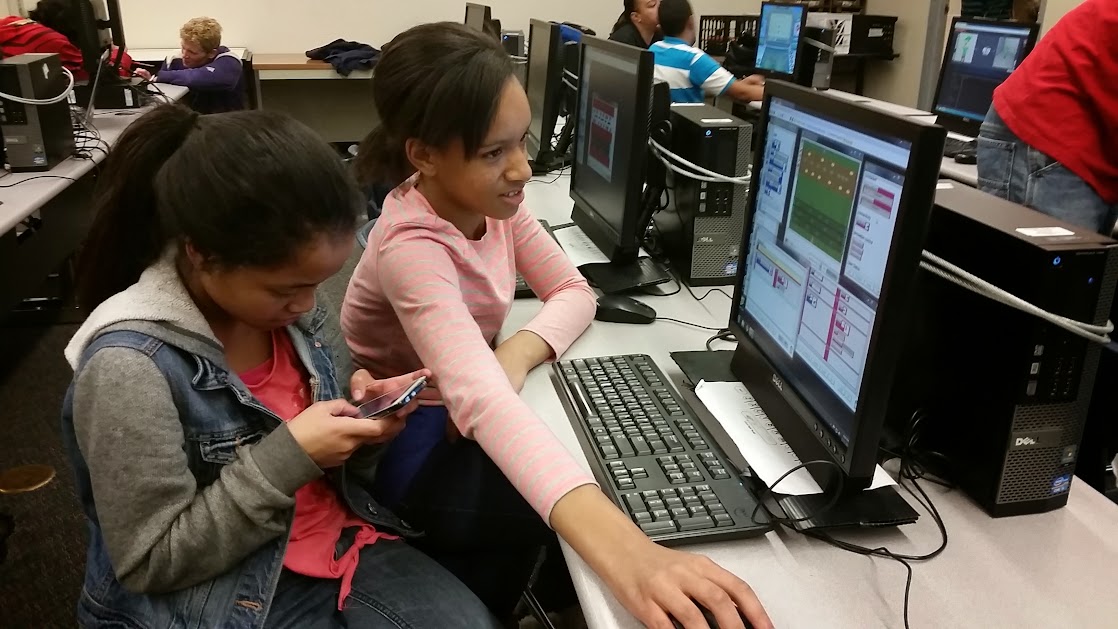
Two girls engaged in Scalable Game Design and mobile computing at Mrachek Middle during Computer Science Education Week. Photo by Joe Dillon
For teachers who engaged students in any kind of coding activity during the week of December 8-14, your reflections on what went well, and what you would do differently are important for you to consider and for the Ed Tech department to know. By sharing your thinking you'll help us be smarter as a system about how we introduce computational thinking skills and strategies to students in order to provide more equitable education in APS. With equity in mind, it is also important that we think together about the equity issues that drive Computer Science Education week and the Hour of Code.